

CO2 export
Smart export solutions for captured CO₂, leveraging Jade Energy’s location and infrastructure to support industrial decarbonization through storage or reuse.
Project overview
Jade Energy will also provide the service of exporting CO₂ from customers throughout Germany and beyond, in line with the envisaged German Carbon Management Strategy from the Federal Government of Germany. This strategy acknowledges the capture of CO₂ for usage and permanent storage as a cornerstone of the energy transition. The new federal government has made CO₂ transportation and export a key part of its policy to decarbonize its hard-to-abate industries.
As Jade Energy is strategically located in Wilhelmshaven, the only deep seaport in Germany, and well connected to rail networks and future CO₂ pipeline infrastructure, it is ideal for CO₂ transport from industrial CO₂ emitters across Germany and Europe. The co-located LNG/e-NG regas facilities will provide significant cooling which will be available for liquefaction of the CO₂. Therewith it will enable significant synergies for CO₂ handling and export.
In addition, the terminal will be able to handle CO₂ captured from future Jade Energy projects, such as once incoming LNG or e-NG will be converted into hydrogen.
Thanks to its ship-based design, the terminal enables flexible transport, either for permanent storage in the North Sea, or for utilization in the production of e-NG and e-fuels in countries with abundant renewable energy. The terminal will consist of a train receiving terminal to unload the CO₂ wagons, an interim storage to absorb fluctuations from the train and ship transport, and a loading infrastructure to load the maritime vessels.
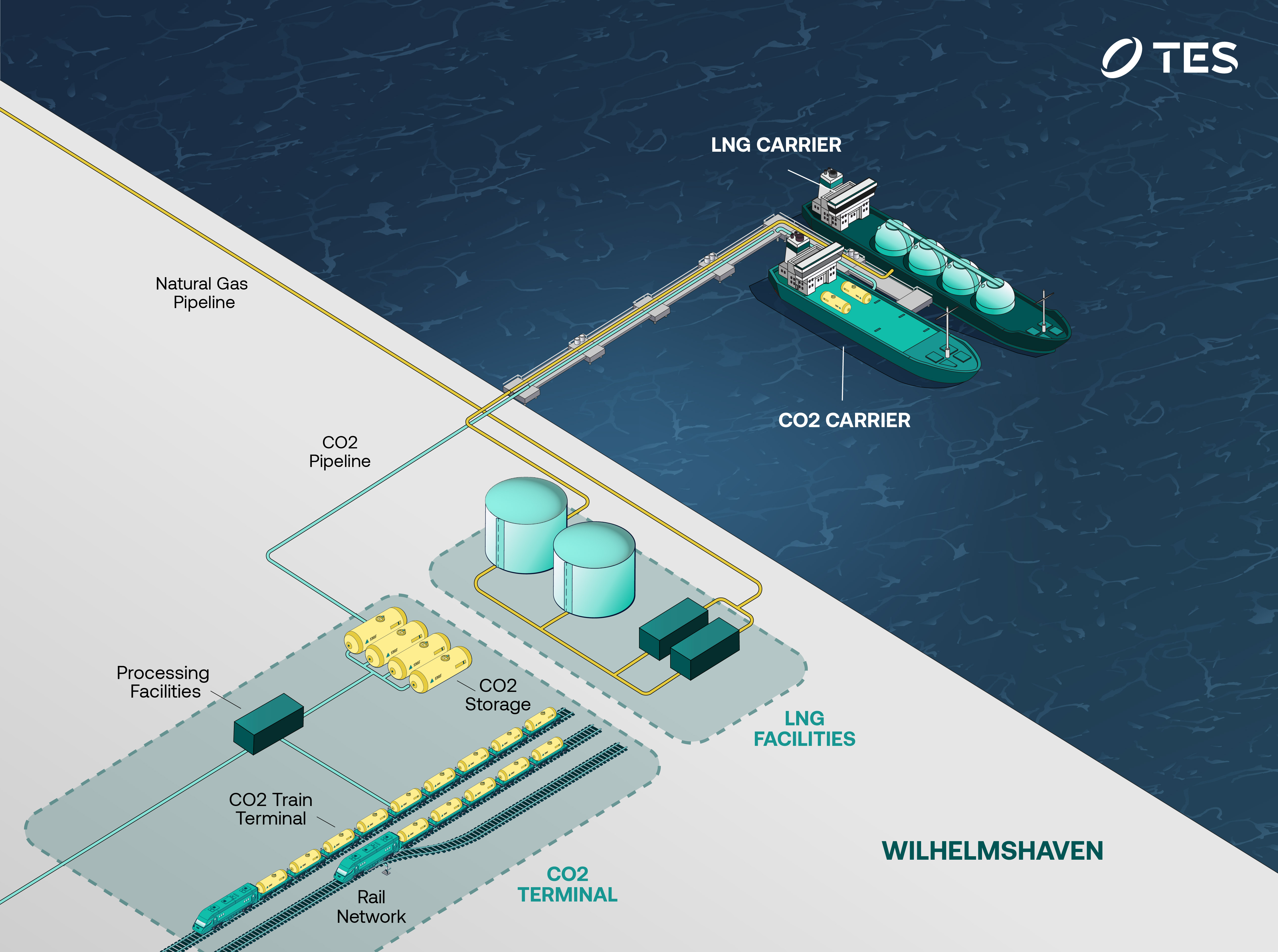
The terminal is planned to start with an initial capacity of 3 to 5 million tons per year (Mtpa), initially brought to the terminal by rail, and can be scaled up according to market developments, potentially expanding to 10 Mtpa. Once the CO₂ onshore pipeline network is built, up to 40 million tons of CO₂ could be delivered and exported, depending on availability of CO₂ customers.
TES and Ramboll, a leading engineering and consultancy firm, have completed a joint engineering study for the Jade Energy terminal. The collaboration assessed technical alternatives for CO₂ imports by rail and exports by ship.
For TES' e-NG business, advancing the long-term ability to establish a closed-loop CO₂ will become increasingly important once CO₂ infrastructure and capturing at emitter sites becomes available on a widely spread level.
TES participates in shaping the future of envisaged Carbon Management in Germany
To support the ongoing development of the terminal, TES is now founding member of the Carbon Management Alliance, an industrial initiative in Germany focused on implementing Carbon Capture, Utilisation and Storage (CCUS) technologies. This expansion supports the organisation's goals to drive innovative cross-industry solutions and create infrastructure for efficient carbon management.
